2.1 Personality and Values
Learning Objectives
- Identify the major personality traits that are relevant to organizational behavior.
- Explain the potential pitfalls of personality testing.
- Describe the relationship between personality and work behaviors.
- Understand what values are.
- Describe the link between values and work behaviors.
Personality
Personality
encompasses a person’s relatively stable feelings, thoughts, and
behavioral patterns. Each of us has a unique personality that
differentiates us from other people, and understanding someone’s
personality gives us clues about how that person is likely to act and
feel in a variety of situations. To manage effectively, it is helpful to
understand the personalities of different employees. Having this
knowledge is also useful for placing people into jobs and organizations.
Figure 2.3

© The New Yorker Collection 2007 Mick Stevens from cartoonbank.com. All Rights Reserved.
If
personality is stable, does this mean that it does not change? You
probably remember how you have changed and evolved as a result of your
own life experiences, parenting style and attention you have received in
early childhood, successes and failures you experienced over the course
of your life, and other life events. In fact, personality does change
over long periods of time. For example, we tend to become more socially
dominant, more conscientious (organized and dependable), and more
emotionally stable between the ages of 20 and 40, whereas openness to
new experiences tends to decline as we age. [1]
In other words, even though we treat personality as relatively stable,
change occurs. Moreover, even in childhood, our personality matters, and
it has lasting consequences for us. For example, studies show that part
of our career success and job satisfaction later in life can be
explained by our childhood personality. [2]
Is
our behavior in organizations dependent on our personality? To some
extent, yes, and to some extent, no. While we will discuss the effects
of personality for employee behavior, you must remember that the
relationships we describe are modest correlations. For example, having a
sociable and outgoing personality may encourage people to seek friends
and prefer social situations. This does not mean that their personality
will immediately affect their work behavior. At work, we have a job to
do and a role to perform. Therefore, our behavior may be more strongly
affected by what is expected of us, as opposed to how we want to behave.
Especially in jobs that involve a lot of autonomy, or freedom,
personality tends to exert a strong influence on work behavior, [3]something to consider when engaging in Organizing activities such as job design or enrichment.
Big Five Personality Traits
How
many personality traits are there? How do we even know? In every
language, there are many words describing a person’s personality. In
fact, in the English language, more than 15,000 words describing
personality have been identified. When researchers analyzed the traits
describing personality characteristics, they realized that many
different words were actually pointing to a single dimension of
personality. When these words were grouped, five dimensions seemed to
emerge, and these explain much of the variation in our personalities. [4]
These five are not necessarily the only traits out there. There are
other, specific traits that represent other dimensions not captured by
the Big Five. Still, understanding them gives us a good start for
describing personality.
Figure 2.4 The Big Five Personality Traits
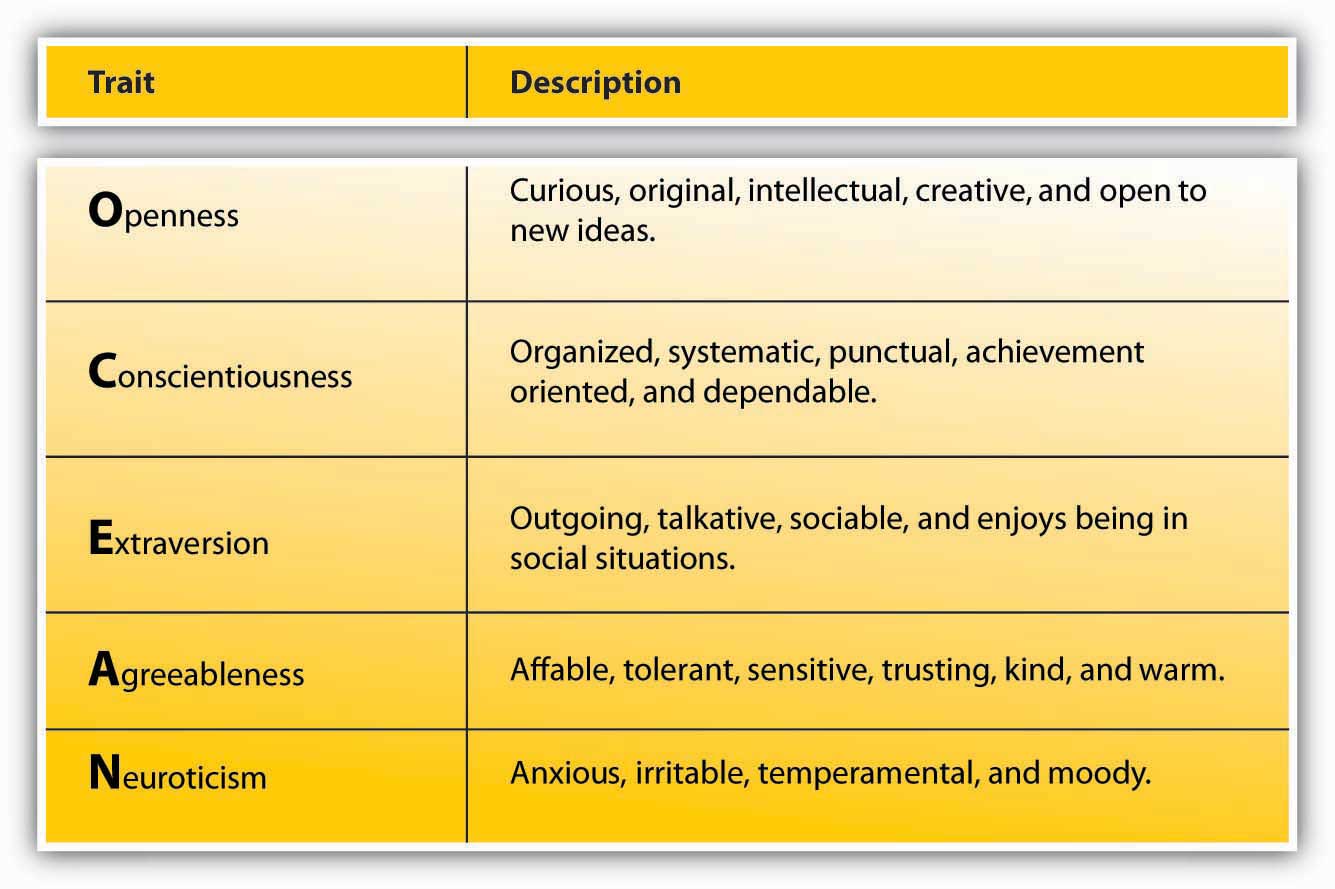
Source: Goldberg, L. R. (1990). An alternative “description of personality”: The big-five factor structure. Journal of Personality & Social Psychology, 59, 1216–1229.
As
you can see, the Big Five dimensions are openness, conscientiousness,
extraversion, agreeableness, and Neuroticism—if you put the initials
together, you get the acronym OCEAN. Everyone has some degree of each of
these traits; it is the unique configuration of how high a person rates
on some traits and how low on others that produces the individual
quality we call personality.
Openness
is the degree to which a person is curious, original, intellectual,
creative, and open to new ideas. People high in openness seem to thrive
in situations that require flexibility and learning new things. They are
highly motivated to learn new skills, and they do well in training
settings. [5]
They also have an advantage when they enter into a new organization.
Their open-mindedness leads them to seek a lot of information and
feedback about how they are doing and to build relationships, which
leads to quicker adjustment to the new job. [6] When given support, they tend to be creative. [7]
Open people are highly adaptable to change, and teams that experience
unforeseen changes in their tasks do well if they are populated with
people high in openness. [8] Compared with people low in openness, they are also more likely to start their own business. [9] The potential downside is that they may also be prone to becoming more easily bored or impatient with routine.
Conscientiousness
refers to the degree to which a person is organized, systematic,
punctual, achievement-oriented, and dependable. Conscientiousness is the
one personality trait that uniformly predicts how high a person’s
performance will be across a variety of occupations and jobs. [10]
In fact, conscientiousness is the trait most desired by recruiters, and
highly conscientious applicants tend to succeed in interviews. [11]
Once they are hired, conscientious people not only tend to perform
well, but they also have higher levels of motivation to perform, lower
levels of turnover, lower levels of absenteeism, and higher levels of
safety performance at work. [12] One’s conscientiousness is related to career success and career satisfaction over time. [13]
Finally, it seems that conscientiousness is a valuable trait for
entrepreneurs. Highly conscientious people are more likely to start
their own business compared with those who are not conscientious, and
their firms have longer survival rates. [14] A potential downside is that highly conscientious individuals can be detail-oriented rather than seeing the big picture.
Figure 2.5

Studies show that there is a relationship between being extraverted and effectiveness as a salesperson.
© 2010 Jupiterimages Corporation
Extraversion
is the degree to which a person is outgoing, talkative, sociable, and
enjoys socializing. One of the established findings is that they tend to
be effective in jobs involving sales. [15] Moreover, they tend to be effective as managers and they demonstrate inspirational leadership behaviors. [16]
extraverts do well in social situations, and, as a result, they tend to
be effective in job interviews. Part of this success comes from
preparation, as they are likely to use their social network to prepare
for the interview. [17]
extraverts have an easier time than introverts do when adjusting to a
new job. They actively seek information and feedback and build effective
relationships, which helps them adjust. [18]
Interestingly, extraverts are also found to be happier at work, which
may be because of the relationships they build with the people around
them and their easier adjustment to a new job. [19]
However, they do not necessarily perform well in all jobs; jobs
depriving them of social interaction may be a poor fit. Moreover, they
are not necessarily model employees. For example, they tend to have
higher levels of absenteeism at work, potentially because they may miss
work to hang out with or attend to the needs of their friends. [20]
Agreeableness
is the degree to which a person is affable, tolerant, sensitive,
trusting, kind, and warm. In other words, people who are high in
agreeableness are likeable people who get along with others. Not
surprisingly, agreeable people help others at work consistently; this
helping behavior does not depend on their good mood. [21] They are also less likely to retaliate when other people treat them unfairly. [22]
This may reflect their ability to show empathy and to give people the
benefit of the doubt. Agreeable people may be a valuable addition to
their teams and may be effective leaders because they create a fair
environment when they are in leadership positions. [23]
At the other end of the spectrum, people low in agreeableness are less
likely to show these positive behaviors. Moreover, people who are
disagreeable are shown to quit their jobs unexpectedly, perhaps in
response to a conflict with a boss or a peer. [24]
If agreeable people are so nice, does this mean that we should only
look for agreeable people when hiring? You might expect some jobs to
require a low level of agreeableness. Think about it: When hiring a
lawyer, would you prefer a kind and gentle person or someone who can
stand up to an opponent? People high in agreeableness are also less
likely to engage in constructive and change-oriented communication. [25]
Disagreeing with the status quo may create conflict, and agreeable
people may avoid creating such conflict, missing an opportunity for
constructive change.
Neuroticism
refers to the degree to which a person is anxious, irritable,
temperamental, and moody. It is perhaps the only Big Five dimension
where scoring high is undesirable. Neurotic people have a tendency to
have emotional adjustment problems and habitually experience stress and
depression. People very high in Neuroticism experience a number of
problems at work. For example, they have trouble forming and maintaining
relationships and are less likely to be someone people go to for advice
and friendship. [26]
They tend to be habitually unhappy in their jobs and report high
intentions to leave, but they do not necessarily actually leave their
jobs. [27]
Being high in Neuroticism seems to be harmful to one’s career, as these
employees have lower levels of career success (measured with income and
occupational status achieved in one’s career). Finally, if they achieve
managerial jobs, they tend to create an unfair climate at work. [28]
In
contrast, people who are low on Neuroticism—those who have a positive
affective disposition—tend to experience positive moods more often than
negative moods. They tend to be more satisfied with their jobs and more
committed to their companies. [29]
This is not surprising, as people who habitually see the glass as half
full will notice the good things in their work environment while those
with the opposite character will find more things to complain about.
Whether these people are more successful in finding jobs and companies
that will make them happy, build better relationships at work that
increase their satisfaction and commitment, or simply see their
environment as more positive, it seems that low Neuroticism is a strong
advantage in the workplace.
Evaluate Yourself on the Big Five Personality Factors
Go to http://www.outofservice.com/bigfive to see how you score on these factors.
Other Personality Dimensions
In
addition to the Big Five, researchers have proposed various other
dimensions, or traits, of personality. These include self-monitoring,
proactive personality, self-esteem, and self-efficacy.
Self-monitoring
refers to the extent to which a person is capable of monitoring his or
her actions and appearance in social situations. People who are social
monitors are social chameleons who understand what the situation demands
and act accordingly, while low social monitors tend to act the way they
feel. [30]
High social monitors are sensitive to the types of behaviors the social
environment expects from them. Their ability to modify their behavior
according to the demands of the situation they are in and to manage
their impressions effectively are great advantages for them. [31] They are rated as higher performers and emerge as leaders. [32]
They are effective in influencing other people and are able to get
things done by managing their impressions. As managers, however, they
tend to have lower accuracy in evaluating the performance of their
employees. It seems that while trying to manage their impressions, they
may avoid giving accurate feedback to their subordinates to avoid
confrontations, which could hinder a manager’s ability to carry out the
Controlling function. [33]
Proactive personality
refers to a person’s inclination to fix what is wrong, change things,
and use initiative to solve problems. Instead of waiting to be told what
to do, proactive people take action to initiate meaningful change and
remove the obstacles they face along the way. Proactive individuals tend
to be more successful in their job searches. [34]
They also are more successful over the course of their careers because
they use initiative and acquire greater understanding of how the
politics within the company work. [35] Proactive people are valuable assets to their companies because they may have higher levels of performance. [36] They adjust to their new jobs quickly because they understand the political environment better and make friends more quickly. [37] Proactive people are eager to learn and engage in many developmental activities to improve their skills. [38]
For all their potential, under some circumstances proactive personality
may be a liability for a person or an organization. Imagine a person
who is proactive but is perceived as too pushy, trying to change things
other people are not willing to let go of, or using their initiative to
make decisions that do not serve a company’s best interests. Research
shows that a proactive person’s success depends on his or her
understanding of the company’s core values, ability, and skills to
perform the job and ability to assess situational demands correctly. [39]
Self-esteem
is the degree to which a person has overall positive feelings about
himself or herself. People with high self-esteem view themselves in a
positive light, are confident, and respect themselves. In contrast,
people with low self-esteem experience high levels of self-doubt and
question their self-worth. High self-esteem is related to higher levels
of satisfaction with one’s job and higher levels of performance on the
job. [40] People with low self-esteem are attracted to situations where they will be relatively invisible, such as large companies. [41]
Managing employees with low self-esteem may be challenging at times
because negative feedback given with the intention of improving
performance may be viewed as a negative judgment on their worth as an
employee. Therefore, effectively managing employees with relatively low
self-esteem requires tact and providing lots of positive feedback when
discussing performance incidents.
Self-Esteem Around the Globe
Which
nations have the highest average self-esteem? Researchers asked this
question by surveying almost 17,000 individuals across 53 nations, in 28
languages.
On the basis of this survey, these are the top 10 nations in terms of self-reported self-esteem:
- Serbia
- Chile
- Israel
- Peru
- Estonia
- United States of America
- Turkey
- Mexico
- Croatia
- Austria
The following are the 10 nations with the lowest self-reported self-esteem:
- South Korea
- Switzerland
- Morocco
- Slovakia
- Fiji
- Taiwan
- Czech Republic
- Bangladesh
- Hong Kong
- Japan
Source: Adapted from
information in Denissen, J. J. A., Penke, L., & Schmitt, D. P.
(2008, July). Self-esteem reactions to social interactions: Evidence for
sociometer mechanisms across days, people, and nations. Journal of Personality & Social Psychology, 95,
181–196; Hitti, M. (2005). Who’s No. 1 in self-esteem? Serbia is tops,
Japan ranks lowest, U.S. is no. 6 in global survey. WebMD. Retrieved
November 14, 2008, from http://www.webmd.com/skin-beauty/news/20050927/whos-number-1-in-self-esteem;
Schmitt, D. P., & Allik, J. (2005). The simultaneous administration
of the Rosenberg self-esteem scale in 53 nationals: Culture-specific
features of global self-esteem. Journal of Personality and Social Psychology, 89, 623–642.
Self-efficacy
is a belief that one can perform a specific task successfully. Research
shows that the belief that we can do something is a good predictor of
whether we can actually do it. Self-efficacy is different from other
personality traits in that it is job specific. You may have high
self-efficacy in being successful academically, but low self-efficacy in
relation to your ability to fix your car. At the same time, people have
a certain level of generalized self-efficacy, and they have the belief
that whatever task or hobby they tackle, they are likely to be
successful in it.
Research shows that self-efficacy at work is related to job performance. [42]
This is probably because people with high self-efficacy actually set
higher goals for themselves and are more committed to their goals,
whereas people with low self-efficacy tend to procrastinate. [43]
Academic self-efficacy is a good predictor of your grade point average,
as well as whether you persist in your studies or drop out of college. [44]
Is
there a way of increasing employee’s self-efficacy? In addition to
hiring people who are capable of performing the required job tasks,
training people to increase their self-efficacy may be effective. Some
people may also respond well to verbal encouragement. By showing that
you believe they can be successful and effectively playing the role of
cheerleader, a manager may be able to increase self-efficacy beliefs.
Empowering people—giving them opportunities to test their skills so that
they can see what they are capable of—is also a good way of increasing
self-efficacy. [45]
Personality Testing in Employee Selection
Personality
is a potentially important predictor of work behavior. In job
interviews, companies try to assess a candidate’s personality and the
potential for a good match, but interviews are only as good as the
people conducting them. In fact, interviewers are not particularly good
at detecting the best trait that predicts performance:
conscientiousness. [46]
One
method some companies use to improve this match and detect the people
who are potentially good job candidates is personality testing. Several
companies conduct preemployment personality tests. Companies using them
believe that these tests improve the effectiveness of their selection
and reduce turnover. For example, Overnight Transportation in Atlanta
found that using such tests reduced their on-the-job delinquency by
50%–100%. [47]
Figure 2.6

Companies such as Kronos and Hogan
Assessments conduct preemployment personality tests. Kronos Incorporated
Headquarters is located in Chelmsford, Massachusetts.
Yet,
are these methods good ways of employee selection? Experts have not yet
reached an agreement on this subject and the topic is highly
controversial. Some experts cite data indicating that personality tests
predict performance and other important criteria such as job
satisfaction. However, we must understand that how a personality test is
used influences its validity. Imagine filling out a personality test in
class. You will probably fill it out as honestly as you can. Then, if
your instructor correlates your personality scores with your class
performance, we could say that the correlation is meaningful. But now
imagine that your instructor tells you, before giving you the test, that
based on your test scores, you will secure a coveted graduate assistant
position, which comes with a tuition waiver and a stipend. In that
case, would you still fill out the test honestly or would you try to
make your personality look as “good” as possible?
In
employee selection, where the employees with the “best” personalities
will be the ones receiving a job offer, a complicating factor is that
people filling out the survey do not have a strong incentive to be
honest. In fact, they have a greater incentive to guess what the job
requires and answer the questions in a way they think the company is
looking for. As a result, the rankings of the candidates who take the
test may be affected by their ability to fake. Some experts believe that
this is a serious problem. [48] Others point out that even with faking the tests remain valid—the scores are related to job performance. [49]
It is even possible that the ability to fake is related to a
personality trait that increases success at work, such as social
monitoring.
Scores
on personality self-assessments are distorted for other reasons beyond
the fact that some candidates can fake better than others. Do we even
know our own personalities? Are we the best person to ask this question?
How supervisors, coworkers, and customers see our personality may
matter more than how we see ourselves. Therefore, using self-report
measures of performance may not be the best way of measuring someone’s
personality. [50]
We have our blind areas. We may also give “aspirational” answers. If
you are asked whether you are honest, you may think “yes, I always have
the intention to be honest.” This actually says nothing about your
actual level of honesty.
Another
problem with using these tests is the uncertain relationship between
performance and personality. On the basis of research, personality is
not a particularly strong indicator of how a person will perform.
According to one estimate, personality only explains about 10%–15% of
variation in job performance. Our performance at work depends on many
factors, and personality does not seem to be the key factor for
performance. In fact, cognitive ability (your overall mental
intelligence) is a more powerful predictor of job performance. Instead
of personality tests, cognitive ability tests may do a better job of
predicting who will be good performers. Personality is a better
predictor of job satisfaction and other attitudes, but screening people
out on the assumption that they may be unhappy at work is a challenging
argument to make in an employee selection context.
In
any case, if an organization decides to use these tests for selection,
it is important to be aware of their limitations. If they are used
together with other tests, such as tests of cognitive abilities, they
may contribute to making better decisions. The company should ensure
that the test fits the job and actually predicts performance. This is
called validating the test. Before giving the test to applicants, the
company could give it to existing employees to find out the traits that
are most important for success in this particular company and job. Then,
in the selection context, the company can pay particular attention to
those traits.
Finally,
the company also needs to make sure that the test does not discriminate
against people on the basis of sex, race, age, disabilities, and other
legally protected characteristics. Rent-a-Center experienced legal
difficulties when the test they used was found to violate the Americans
with Disabilities Act (ADA). The company used the Minnesota Multiphasic
Personality Inventory for selection purposes, but this test was
developed to diagnose severe mental illnesses; it included items such as
“I see things or people around me others do not see.” In effect, the
test served the purpose of a clinical evaluation and was discriminating
against people with mental illnesses, which is a protected category
under ADA. [51]
Values
Figure 2.7 Values Included in Schwartz’s (1992) Value Inventory

Values
refer to people’s stable life goals, reflecting what is most important
to them. Values are established throughout one’s life as a result of
accumulating life experiences, and values tend to be relatively stable. [52]
The values that are important to a person tend to affect the types of
decisions they make, how they perceive their environment, and their
actual behaviors. Moreover, a person is more likely to accept a job
offer when the company possesses the values he or she cares about. [53]
Value attainment is one reason people stay in a company. When a job
does not help them attain their values, they are likely to decide to
leave if they are dissatisfied with the job. [54]
What
are the values people care about? As with personality dimensions,
researchers have developed several frameworks, or typologies, of values.
One of the particularly useful frameworks includes 10 values. [55]
Figure 2.8

A person who has a strong stimulation orientation may pursue extreme sports.
© 2010 Jupiterimages Corporation
Values
a person holds will affect their employment. For example, someone who
values stimulation highly may seek jobs that involve fast action and
high risk, such as firefighter, police officer, or emergency medicine.
Someone who values achievement highly may be likely to become an
entrepreneur or intrapreneur. And an individual who values benevolence
and universalism may seek work in the nonprofit sector with a charitable
organization or in a “helping profession,” such as nursing or social
work. Like personality, values have implications for Organizing
activities, such as assigning duties to specific jobs or developing the
chain of command; employee values are likely to affect how employees
respond to changes in the characteristics of their jobs.
In
terms of work behaviors, a person is more likely to accept a job offer
when the company possesses the values he or she cares about. A firm’s
values are often described in the company’s mission and vision
statements, an element of the Planning function. [56]
Value attainment is one reason people stay in a company. When a job
does not help them attain their values, they are likely to decide to
leave if they are also dissatisfied with the job. [57]
Key Takeaway
Personality
traits and values are two dimensions on which people differ. Personality
is the unique, relatively stable pattern of feelings, thoughts, and
behavior that each individual displays. Big Five personality dimensions
(openness, conscientiousness, extraversion, agreeableness, and
Neuroticism) are important traits; others that are particularly relevant
for work behavior include self-efficacy, self-esteem, social
monitoring, and proactive personality. While personality is a stronger
influence over job attitudes, its relation to job performance is weaker.
Some companies use personality testing to screen out candidates.
Companies using personality tests are advised to validate their tests
and use them to supplement other techniques with greater validity, such
as tests of cognitive ability. Companies must also ensure that a test
does not discriminate against any protected group. Values express a
person’s life goals; they are similar to personality traits in that they
are relatively stable over time. In the workplace, a person is more
likely to accept a job that provides opportunities for value attainment.
People are also more likely to remain in a job and career that satisfy
their values.
Exercises
- Think about the personality traits covered in this section. Can you think of jobs or occupations that seem particularly suited to each trait? Which traits would be universally desirable across all jobs?
- What are the unique challenges of managing employees who have low self-efficacy and self-esteem? How would you deal with this situation?
- What are some methods that companies can use to assess employee personality?
- Have you ever held a job where your personality did not match the demands of the job? How did you react to this situation? How were your attitudes and behaviors affected?
- Identify ways in which the Big Five (of the manager and/or the employees) may affect how you as a manager would carry out the Leadership function.
[1] Roberts,
B. W., Walton, K. E., & Viechtbauer, W. (2006). Patterns of
mean-level change in personality traits across the life course: A
meta-analysis of longitudinal studies. Psychological Bulletin, 132, 1–25.
[2] Judge,
T. A., & Higgins, C. A. (1999). The big five personality traits,
general mental ability, and career success across the life span. Personnel Psychology, 52,
621–652; Staw, B. M., Bell, N. E., & Clausen, J. A. (1986). The
dispositional approach to job attitudes: A lifetime longitudinal test. Administrative Science Quarterly, 31, 56–77.
[3] Barrick,
M. R., & Mount, M. K. (1993). Autonomy as a moderator of the
relationships between the big five personality dimensions and job
performance. Journal of Applied Psychology, 78, 111–118.
[4] Goldberg, L. R. (1990). An alternative “description of personality”: The big-five factor structure. Journal of Personality & Social Psychology, 59, 1216–1229.
[5] Barrick, M. R., & Mount, M. K. (1991). The big five personality dimensions and job performance: A meta-analysis. Personnel Psychology, 44,
1–26; Lievens, F., Harris, M. M., Van Keer, E., & Bisqueret, C.
(2003). Predicting cross-cultural training performance: The validity of
personality, cognitive ability, and dimensions measured by an assessment
center and a behavior description interview. Journal of Applied Psychology, 88, 476–489.
[6] Wanberg, C. R., & Kammeyer-Mueller, J. D. (2000). Predictors and outcomes of proactivity in the socialization process. Journal of Applied Psychology, 85, 373–385.
[7] Baer,
M., & Oldham, G. R. (2006). The curvilinear relation between
experienced creative time pressure and creativity: Moderating effects of
openness to experience and support for creativity. Journal of Applied Psychology, 91, 963–970.
[8] LePine,
J. A. (2003). Team adaptation and postchange performance: Effects of
team composition in terms of members’ cognitive ability and personality.
Journal of Applied Psychology, 88, 27–39.
[9] Zhao, H., & Seibert, S. E. (2006). The big five personality dimensions and entrepreneurial status: A meta-analytic review. Journal of Applied Psychology, 91, 259–271.
[10] Barrick, M. R., & Mount, M. K. (1991). The big five personality dimensions and job performance: A meta-analysis. Personnel Psychology, 44, 1–26.
[11] Dunn,
W. S., Mount, M. K., Barrick, M. R., & Ones, D. S. (1995). Relative
importance of personality and general mental ability in managers’
judgments of applicant qualifications. Journal of Applied Psychology, 80,
500–509; Tay, C., Ang, S., & Van Dyne, L. (2006). Personality,
biographical characteristics, and job interview success: A longitudinal
study of the mediating effects of interviewing self-efficacy and the
moderating effects of internal locus of control. Journal of Applied Psychology, 91, 446–454.
[12] Judge, T. A., & Ilies, R. (2002). Relationship of personality to performance motivation: A meta-analytic review. Journal of Applied Psychology,
87, 797–807; Judge, T. A., Martocchio, J. J, & Thoresen, C. J.
(1997). Five-factor model of personality and employee absence. Journal of Applied Psychology, 82,
745–755; Wallace, C., & Chen, G. (2006). A multilevel integration
of personality, climate, self-regulation, and performance. Personnel Psychology, 59,
529–557; Zimmerman, R. D. (2008). Understanding the impact of
personality traits on individuals’ turnover decisions: A meta-analytic
path model. Personnel Psychology, 61, 309–348.
[13] Judge,
T. A., & Higgins, C. A. (1999). The big five personality traits,
general mental ability, and career success across the life span. Personnel Psychology, 52, 621–652.
[14] Certo, S. T., & Certo, S. C. (2005). Spotlight on entrepreneurship. Business Horizons, 48,
271–274; Zhao, H., & Seibert, S. E. (2006). The big five
personality dimensions and entrepreneurial status: A meta-analytic
review. Journal of Applied Psychology, 91, 259–271.
[15] Barrick, M. R., & Mount, M. K. (1991). The big five personality dimensions and job performance: A meta-analysis. Personnel Psychology, 44,
1–26; Vinchur, A. J., Schippmann, J. S., Switzer, F. S., & Roth, P.
L. (1998). A meta-analytic review of predictors of job performance for
salespeople. Journal of Applied Psychology, 83, 586–597.
[16] Bauer,
T. N., Erdogan, B., Liden, R. C., & Wayne, S. J. (2006). A
longitudinal study of the moderating role of extraversion: Leader-member
exchange, performance, and turnover during new executive development. Journal of Applied Psychology, 91,
298–310; Bono, J. E., & Judge, T. A. (2004). Personality and
transformational and transactional leadership: A meta-analysis. Journal of Applied Psychology, 89, 901–910.
[17] Caldwell, D. F., & Burger, J. M. (1998). Personality characteristics of job applicants and success in screening interviews. Personnel Psychology, 51,
119–136; Tay, C., Ang, S., & Van Dyne, L. (2006). Personality,
biographical characteristics, and job interview success: A longitudinal
study of the mediating effects of interviewing self-efficacy and the
moderating effects of internal locus of control. Journal of Applied Psychology, 91, 446–454.
[18] Wanberg, C. R., & Kammeyer-Mueller, J. D. (2000). Predictors and outcomes of proactivity in the socialization process. Journal of Applied Psychology, 85, 373–385.
[19] Judge, T. A. Heller, D., & Mount, M. K. (2002). Five-factor model of personality and job satisfaction: A meta-analysis. Journal of Applied Psychology, 87, 530–541.
[20] Judge, T. A., Martocchio, J. J., & Thoresen, C. J. (1997). Five-factor model of personality and employee absence. Journal of Applied Psychology, 82, 745–755.
[21] Ilies,
R., Scott, B. A., & Judge, T. A. (2006). The interactive effects of
personal traits and experienced states on intraindividual patterns of
citizenship behavior. Academy of Management Journal, 49, 561–575.
[22] Skarlicki,
D. P., Folger, R., & Tesluk, P. (1999). Personality as a moderator
in the relationship between fairness and retaliation. Academy of Management Journal, 42, 100–108.
[23] Mayer,
D., Nishii, L., Schneider, B., & Goldstein, H. (2007). The
precursors and products of justice climates: Group leader antecedents
and employee attitudinal consequences. Personnel Psychology, 60, 929–963.
[24] Zimmerman,
R. D. (2008). Understanding the impact of personality traits on
individuals’ turnover decisions: A meta-analytic path model. Personnel Psychology, 61, 309–348.
[25] LePine,
J. A., & Van Dyne, L. (2001). Voice and cooperative behavior as
contrasting forms of contextual performance: Evidence of differential
relationships with big five personality characteristics and cognitive
ability. Journal of Applied Psychology, 86, 326–336.
[26] Klein,
K. J., Beng-Chong, L., Saltz, J. L., & Mayer, D. M. (2004). How do
they get there? An examination of the antecedents of centrality in team
networks. Academy of Management Journal, 47, 952–963.
[27] Judge, T. A., Heller, D., & Mount, M. K. (2002). Five-factor model of personality and job satisfaction: A meta-analysis. Journal of Applied Psychology, 87,
530–541; Zimmerman, R. D. (2008). Understanding the impact of
personality traits on individuals’ turnover decisions: A meta-analytic
path model. Personnel Psychology, 61, 309–348.
[28] Mayer,
D., Nishii, L., Schneider, B., & Goldstein, H. (2007). The
precursors and products of justice climates: Group leader antecedents
and employee attitudinal consequences. Personnel Psychology, 60, 929–963.
[29] Connolly, J. J., & Viswesvaran, C. (2000). The role of affectivity in job satisfaction: A meta-analysis. Personality and Individual Differences, 29,
265–281; Thoresen, C. J., Kaplan, S. A., Barsky, A. P., de Chermont,
K., & Warren, C. R. (2003). The affective underpinnings of job
perceptions and attitudes: A meta-analytic review and integration. Psychological Bulletin, 129, 914–945.
[30] Snyder, M. (1974). Self-monitoring of expressive behavior. Journal of Personality and Social Psychology, 30, 526–537; Snyder, M. (1987). Public Appearances/Public Realities: The Psychology of Self-Monitoring. New York: Freeman.
[31] Turnley,
W. H., & Bolino, M. C. (2001). Achieving desired images while
avoiding undesired images: Exploring the role of self-monitoring in
impression management. Journal of Applied Psychology, 86, 351–360.
[32] Day,
D. V., Schleicher, D. J., Unckless, A. L., & Hiller, N. J. (2002).
Self-monitoring personality at work: A meta-analytic investigation of
construct validity. Journal of Applied Psychology, 87, 390–401.
[33] Jawahar, I. M. (2001). Attitudes, self-monitoring, and appraisal behaviors. Journal of Applied Psychology, 86, 875–883.
[34] Brown,
D. J., Cober, R. T., Kane, K., Levy, P. E., & Shalhoop, J. (2006).
Proactive personality and the successful job search: A field
investigation with college graduates. Journal of Applied Psychology, 91, 717–726.
[35] Seibert, S. E. (1999). Proactive personality and career success. Journal of Applied Psychology, 84,
416–427; Seibert, S. E., Kraimer, M. L., & Crant, M. J. (2001).
What do proactive people do? A longitudinal model linking proactive
personality and career success. Personnel Psychology, 54, 845–874.
[36] Crant, M. J. (1995). The proactive personality scale and objective job performance among real estate agents. Journal of Applied Psychology, 80, 532–537.
[37] Kammeyer-Mueller,
J. D., & Wanberg, C. R. (2003). Unwrapping the organizational entry
process: Disentangling multiple antecedents and their pathways to
adjustment. Journal of Applied Psychology, 88, 779–794; Thompson, J. A. (2005). Proactive personality and job performance: A social capital perspective. Journal of Applied Psychology, 90, 1011–1017.
[38] Major,
D. A., Turner, J. E., & Fletcher, T. D. (2006). Linking proactive
personality and the big five to motivation to learn and development
activity. Journal of Applied Psychology, 91, 927–935.
[39] Chan,
D. (2006). Interactive effects of situational judgment effectiveness
and proactive personality on work perceptions and work outcomes. Journal of Applied Psychology, 91,
475–481; Erdogan, B., & Bauer, T. N. (2005). Enhancing career
benefits of employee proactive personality: The role of fit with jobs
and organizations. Personnel Psychology, 58, 859–891.
[40] Judge,
T. A., & Bono, J. E. (2001). Relationship of core self-evaluations
traits—self esteem, generalized self efficacy, locus of control, and
emotional stability—with job satisfaction and job performance: A
meta-analysis. Journal of Applied Psychology, 86, 80–92.
[41] Turban, D. B., & Keon, T. L. (1993). Organizational attractiveness: An interactionist perspective. Journal of Applied Psychology, 78, 184–193.
[42] Bauer,
T. N., Bodner, T., Erdogan, B., Truxillo, D. M., & Tucker, J. S.
(2007). Newcomer adjustment during organizational socialization: A
meta-analytic review of antecedents, outcomes, and methods. Journal of Applied Psychology, 92,
707–721; Judge, T. A., Jackson, C. L., Shaw, J. C., Scott, B. A., &
Rich, B. L. (2007). Self-efficacy and work-related performance: The
integral role of individual differences. Journal of Applied Psychology, 92, 107–127; Stajkovic, A. D., & Luthans, F. (1998). Self-efficacy and work-related performance: A meta-analysis. Psychological Bulletin, 124, 240–261.
[43] Phillips,
J. M., & Gully, S. M. (1997). Role of goal orientation, ability,
need for achievement, and locus of control in the self-efficacy and
goal-setting process. Journal of Applied Psychology, 82, 792–802;
Steel, P. (2007). The nature of procrastination: A meta-analytic and
theoretical review of quintessential self-regulatory failure. Psychological Bulletin, 133,
65–94; Wofford, J. C., Goodwin, V. L., & Premack, S. (1992).
Meta-analysis of the antecedents of personal goal level and of the
antecedents and consequences of goal commitment. Journal of Management, 18, 595–615.
[44] Robbins,
S. B., Lauver, K., Le, H., Davis, D., Langley, R., & Carlstrom, A.
(2004). Do psychosocial and study skill factors predict college
outcomes? A meta-analysis. Psychological Bulletin, 130, 261–288.
[45] Ahearne,
M., Mathieu, J., & Rapp, A. (2005). To empower or not to empower
your sales force? An empirical examination of the influence of
leadership empowerment behavior on customer satisfaction and
performance. Journal of Applied Psychology, 90, 945–955.
[46] Barrick,
M. R., Patton, G. K., & Haugland, S. N. (2000). Accuracy of
interviewer judgments of job applicant personality traits. Personnel Psychology, 53, 925–951.
[47] Emmett, A. (2004, October). Snake oil or science? That’s the raging debate on personality testing. Workforce Management, 83, 90–92; Gale, S. F. (2002, April). Three companies cut turnover with tests. Workforce, 81 (4), 66–69.
[48] Morgeson,
F. P., Campion, M. A., Dipboye, R. L., Hollenbeck, J. R., Murphy, K.,
& Schmitt, N. (2007). Reconsidering the use of personality tests in
personnel selection contexts. Personnel Psychology, 60, 683–729;
Morgeson, F. P., Campion, M. A., Dipboye, R. L., Hollenbeck, J. R.,
Murphy, K., & Schmitt, N. (2007). Are we getting fooled again?
Coming to terms with limitations in the use of personality tests for
personnel selection. Personnel Psychology, 60, 1029–1049.
[49] Barrick,
M. R., & Mount, M. K. (1996). Effects of impression management and
self-deception on the predictive validity of personality constructs. Journal of Applied Psychology, 81,
261–272; Ones, D. S., Dilchert, S., Viswesvaran, C., & Judge, T. A.
(2007). In support of personality assessment in organizational
settings. Personnel Psychology, 60, 995–1027; Ones, D. S.,
Viswesvaran, C., & Reiss, A. D. (1996). Role of social desirability
in personality testing for personnel selection. Journal of Applied Psychology, 81,
660–679; Tett, R. P., & Christiansen, N. D. (2007). Personality
tests at the crossroads: A response to Morgeson, Campion, Dipboye,
Hollenbeck, Murphy, and Schmitt (2007). Personnel Psychology, 60, 967–993.
[50] Mount, M. K., Barrick, M. R., & Strauss, J. P. (1994). Validity of observer ratings of the big five personality factors. Journal of Applied Psychology, 79, 272–280.
[51] Heller, M. (2005, September). Court ruling that employer’s integrity test violated ADA could open door to litigation. Workforce Management, 84 (9), 74–77.
[52] Lusk, E. J., & Oliver, B. L. (1974). Research notes. American manager’s personal value systems-revisited. Academy of Management Journal, 17 (3), 549–554; Rokeach, M. (1973). The Nature of Human Values. New York: Free Press.
[53] Judge, T. A., & Bretz, R. D. (1992). Effects of work values on job choice decisions. Journal of Applied Psychology, 77,
261–271; Ravlin, E. C., & Meglino, B. M. (1987). Effect of values
on perception and decision making: A study of alternative work values
measures. Journal of Applied Psychology, 72, 666–673.
[54] George,
J. M., & Jones, G. R. (1996). The experience of work and turnover
intentions: Interactive effects of value attainment, job satisfaction,
and positive mood. Journal of Applied Psychology, 81, 318–325.
[55] Schwartz,
S. H. (1992). Universals in the content and structure of values:
Theoretical advances and empirical tests in 20 countries. In M. Zanna
(Ed.), Advances in Experimental Social Psychology (pp. 1–65). San Diego: Academic Press.
[56] Judge, T. A., & Bretz, R. D. (1992). Effects of work values on job choice decisions. Journal of Applied Psychology, 77,
261–271; Ravlin, E. C., & Meglino, B. M. (1987). Effect of values
on perception and decision making: A study of alternative work values
measures. Journal of Applied Psychology, 72, 666–673.
[57] George,
J. M., & Jones, G. R. (1996). The experience of work and turnover
intentions: Interactive effects of value attainment, job satisfaction,
and positive mood. Journal of Applied Psychology, 81, 318–325.
©2014 Flat World Education, Inc. Terms of Use

